Twyfelfontein
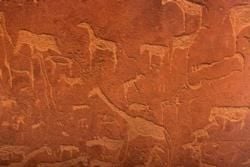
In 1947 David Levin settled in the Damaraland area in order to farm the countryside. He noted several rock engravings and paintings on the stony outcrops surrounding a spring. The spring unfortunately did not yield enough water to sustain him and his livestock. Doubting the feasibility of the spring as time went by a Afrikaans speaking friend began referring to him as "David Twyfelfontein" meaning "David doubts the spring". The name stuck and when David Levin registered his farm in 1948 he named it Twyfelfontein. Rock engravings and paintings have been recorded in the area since 1921 but it was only in 1950 that their true wealth was described by Ernst Rudolph Scherz. Over 5,000 individual artworks have been recorded since and stone artifacts and beaded jewelry have also been found. The area was proclaimed as Namibia’s first World Heritage Site in 2007 and contains beautiful and intriguing depictions of animals such as eland, kudu, lion, ostriches and giraffes. One of the more famous ones is that of the "Lion Man". It depicts the body of a lion with its tail in the shape of a human arm and hand. Painted by the San or Bushman communities, they are estimated at an age of over 3,000 years and form a very important part of Namibia’s cultural heritage.
VIEW ACCOMMODATION FOR TWYFELFONTEIN AREA
Towns:
Things to See: